
 ES
ES  EN
EN 
When an immigrant child arrives in the United States without a parent or legal guardian, or when they have been abandoned, abused, or neglected, the road forward can feel overwhelming. Fortunately, there is a legal pathway designed specifically to protect these young people. Special Immigrant Juvenile Status, commonly known as SIJS, offers a route to lawful permanent residency for children who have suffered certain hardships. What many people do not realize, however, is that a Texas family court plays a critical role in making that pathway possible.
What Is Special Immigrant Juvenile Status?
Special Immigrant Juvenile Status is a federal immigration classification created to protect immigrant children who have been abused, abandoned, or neglected by one or both parents. Once granted, SIJS can lead to a green card, giving the child the ability to live and work in the United States permanently.
To qualify, a child must meet several key requirements:
- They must be under 21 years of age at the time of filing.
- They must be unmarried.
- They must have been declared dependent in a juvenile court or placed in the custody of a state agency or individual appointed by a state court.
- A court must have determined that it is not in their best interest to be returned to their home country or the country of their last habitual residence.
- A court must have found that reunification with one or both parents is not viable due to abuse, abandonment, neglect, or a similar basis under state law.
That third, fourth, and fifth requirement is where Texas family courts come into the picture in a meaningful way.
Why a Court Order Is Required
The U.S. Citizenship and Immigration Services, which is the federal agency that processes SIJS petitions, does not make the initial findings about a child’s family situation. Instead, it relies on a state court to make those determinations first. This means that before a child can even file the federal SIJS petition, they need a valid court order from a state court.
This court order, sometimes called a predicate order, must contain specific findings. It is not enough for the order to simply place a child with a guardian. The language of the order matters enormously and must reflect the legal standards required by federal immigration law. A predicate order that is missing even one required finding can result in a denied SIJS petition. States courts have their own requirements and deadlines. In Texas, a predicate court order must be signed before the child ages out at 18 years old. (Tex. Fam. Code Ann. § 101.003(a) (2025) (child/minor). Tex. Civ. Prac. & Rem. Code Ann. §129.001 (2025) (age of majority).
How Texas Family Courts Make These Findings
In Texas, several types of proceedings can give rise to the predicate order needed for SIJS. The most common include:
- Guardianship proceedings in probate court: When a non-parent seeks legal guardianship of a child, the court can make findings about parental unfitness, abandonment, or abuse as part of that process.
- Suits Affecting the Parent-Child Relationship (SAPCR): These are civil family law cases that address custody, conservatorship, and the parent-child relationship. A SAPCR can result in findings that support an SIJS petition.
- Child Protective Services cases: When the Texas Department of Family and Protective Services is involved and a child is placed in state custody, the court overseeing that case may be able to make the required findings.
The type of proceeding that makes the most sense will depend on the child’s specific circumstances, who is seeking custody or guardianship, and what evidence is available about the parent-child relationship.
The Best Interest of the Child Standard
One of the required findings for SIJS is that it would not be in the child’s best interest to be returned to their home country. This is a standard that Texas family courts are very familiar with, because it is the same standard used in custody and guardianship decisions generally.
When making this determination, a court may consider a wide range of factors, including:
- The conditions in the child’s country of origin, including safety, stability, and access to basic needs.
- Whether the child has family members in their home country who are able and willing to care for them.
- The child’s current ties to the United States, including school enrollment, community connections, and relationships with caregivers.
- Any trauma or harm the child has experienced, including domestic violence, gang persecution, or parental neglect.
- The child’s own wishes, depending on their age and maturity.
Judges in Texas family courts are not immigration judges, and they are not being asked to rule on immigration status directly. Their role is narrowly focused on the child’s welfare under state family law. However, those findings have significant downstream effects on the child’s ability to pursue immigration relief.
What Happens After the Court Order
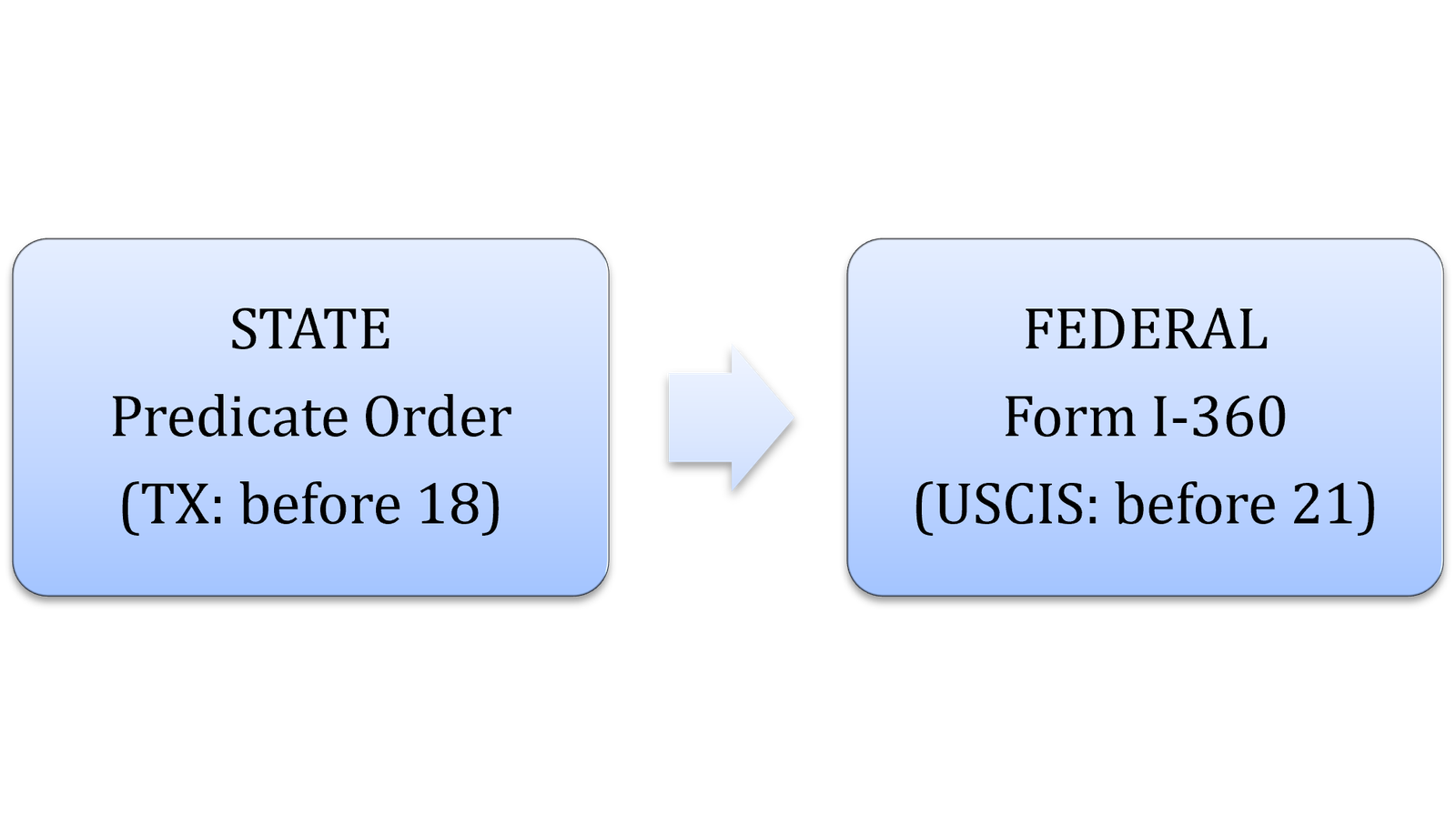
Once a Texas family court issues the predicate order with the required findings, the child’s attorney can use it to file Form I-360, the federal SIJS petition, with U.S. Citizenship and Immigration Services. This form asks the federal government to recognize the child as a Special Immigrant Juvenile based on the state court findings.
If the I-360 petition is approved, the child can then apply for lawful permanent residency, commonly known as a green card. This step involves filing Form I-485, the Application to Register Permanent Residence or Adjust Status.
It is important to understand that approval of the I-360 does not automatically mean the child will receive a green card right away. The availability of a green card depends on the child’s country of birth and whether a visa number is immediately available under the annual visa quota system. Children from countries with high demand for immigration, such as Mexico, El Salvador, Guatemala, and Honduras, may face waiting periods before a visa number becomes available.
Common Challenges in the SIJS Process
While SIJS is a vital protection for vulnerable children, the process is not without its difficulties. Families and advocates often encounter several obstacles along the way:
- Age deadlines: Because the child must be under 21 at the time of filing the I-360 petition, timing is critical. Delays in obtaining the predicate order can put the entire process at risk if the child is approaching that age cutoff.
- Language barriers: Many children and their caregivers speak little to no English, which makes navigating court proceedings difficult without qualified legal representation and interpretation services.
- Obtaining evidence: Proving abuse, abandonment, or neglect can require documentation from another country, sworn statements, or testimony from witnesses who may be hard to locate.
- Incorrect predicate orders: If the court order does not include all the required findings or uses imprecise language, the I-360 petition may be denied. This makes it essential to work with an attorney who understands both family law and immigration law.
- Jurisdiction questions: Courts in some counties may be unfamiliar with SIJS proceedings, and judges may need guidance on what findings are required and why.
The Role of an Attorney in SIJS Cases
Given the complexity of SIJS cases, having a knowledgeable attorney is not just helpful, it is often the difference between success and failure. An attorney who understands both Texas family law and federal immigration law can:
- Identify the most appropriate type of court proceeding for the child’s situation.
- Draft the petition or motion in a way that clearly sets up the required findings.
- Prepare the child and their caregiver for court hearings.
- Review and verify the language of the predicate order before it is filed.
- File the I-360 petition and any supporting documentation with U.S. Citizenship and Immigration Services.
- Monitor the case for updates, including visa bulletin movements that affect when the child can apply for a green card.
At Suday Law, helping families navigate these layered legal processes is at the heart of what we do. SIJS cases require a clear understanding of how state family court proceedings and federal immigration law work together, and that intersection is where the right legal guidance makes all the difference.
Who Can File for SIJS in Texas
A common misconception is that SIJS is only available to children who entered the United States without authorization. In reality, the child’s manner of entry is not the determining factor. SIJS is available to immigrant children regardless of how they entered the country, as long as they meet the eligibility requirements related to their family situation and age.
Additionally, the process is available to children who are in the care of a non-parent relative, such as an aunt, uncle, grandparent, or older sibling. It is also available when a non-relative adult has stepped in to provide care. The key is that a court must formally recognize that custody or guardianship arrangement and make the required findings about the child’s parents.
Take the Next Step for a Child You Care About
If you are caring for an immigrant child who has been abandoned, abused, or neglected by one or both parents, Special Immigrant Juvenile Status may offer a path to safety and stability that the child deserves. The process involves both Texas family court and federal immigration proceedings, and every step matters. From the language in the predicate order to the timing of the federal petition, the details of this process can have lasting consequences for a child’s future. Reaching out to an experienced immigration and family law attorney as early as possible gives the child the best chance at a successful outcome. The legal system can be complex, but with the right support, it can also be a powerful tool for protecting the most vulnerable among us. Do not wait until an age deadline is near or a crisis makes action urgent. Start the conversation today and take the first step toward securing a stable future for the child in your care.